Saturday, October 13, 2007

Boat trip to Pine Cay, wrecked sloops, waterfront houses,

We woke up this morning without rain showers. Murphy's law, of course. As soon as someone asks for more weather photos, it clears up. We'll have to remember that technique, it could be useful.

We were sitting on the porch this morning having our coffee, awaiting the dawn. Reminded me of an old Charlie Daniel's Band song.."High Lonesome" in some ways. "Just you and me and a little white pup, sitting here waiting for the sun to come up...."


(sorry for the grainy blur...there's not much light yet at this time of day. But oh, there will be, later)

We decided that we will grab this weather window and boat over to Pine Cay this morning. The first house guests of the season are arriving there next Saturday, and we want to make sure the house is ready. All the window cranks work, that the new refrigerator was delivered and installed and is working and the ice trays are filled. I will adjust all the rollers on the sliding screen doors, and make sure all the screens are intact. Just generally making sure everything in the house works so that their vacation is as smooth as we can make our part of it. They are family friends, and very interesting people, but that's another story.

We will take the 'back way' over the Bank this morning, instead of our usual trip through Leeward and up the outside. Its kind of tricky, involving a lot of little solid rock islands, shifting sand bars, shallow channels, and skinny water. Its shorter than going through Leeward by about a mile, but in the past we have tended to avoid it except in bad weather. We have never done it at night. But now that we no longer will be stopping in Leeward for fuel, or to catch up with friends hanging around the dock, its a good time to learn this route like the back of my hand. I suspect we will be using it more and more as time goes on and things get congested in our old stomping ground. But if you are ever going to run aground down here, this is a real good route to take to increase the chances of that experience.

Its also the route the locals use more than any other. Its the most direct route from Provo to the settlements on North and Middle Caicos, and also to the town on South Caicos. The hotel excursion and dive boats, and the Parrot Cay boats don't typically go this way, they draw too much water. Any boat that draws more than three feet, max, should definitely avoid this route. Even a two foot draft should run it only at high tide.

So, we should be able to get some photos of that side that we haven't posted before. Will be more of the same, I am afraid, little islands and shallow, crystal clear water. Could be worse.

We did make the Pine Cay trip this morning. We got a fairly early start ( for us) and were back by mid-afternoon. We took a little over a hundred photos, so I will pick some out to post.

I know I have mentioned the roads here. Why we drive little 4x4s. The road to our house site is over 3 miles of rutted rock and loose gravel after leaving the pavement. The road to the marina is worse. Here are some examples:

This section gets treacherous when its raining. The sand washes out of the ruts cut into the rock. Last month a lawyer was heading home after celebrating a court case he won on behalf of Beaches employees, and he hit these very ruts in his jeep, lost it, slammed into a little cliff without wearing a seatbelt, and he died. That was while we were in Massachusetts visiting.


This is supposed to be two lane here. Its wide enough, but everyone drives on the more packed side, of course:


A couple miles of this stuff, then a little turnoff, and over a hump:


across a dirt parking lot, then we are at the boat. We drove the boat here on its trailer one time, the day we launched it back in early April. It has been in the water since then. And the trailer is at the boatyard. Someone on THT had asked me why I didn't trailer the boat. I think this might give you an idea why we like to leave it in the water.

We clear the marina, and head toward Leeward. To take this route, I have found that if I just steer 060 deg. magnetic, for about 9.4 miles, we come to one of the TCI's well established, aids to navigation installations:


When we first got here, this spot was marked with a 55 gallon drum impaled on a piece of 4" PVC driven into the bottom. The steel drum is long gone, of course, but people come by here and hang buoys, or stick something in the sand to mark this point. If you go thirty yards beyond this, you are probably going to be hard aground. The good news is that if you radio someone and tell them you are here, they will know exactly where you are.

And no, there's no numbers, no bells, no radar reflector, no light. Its not on any chart. Its not maintained by the Coast Guard. Its just, well, what you see.
Welcome to our world.

From this point, you are about two miles almost due South from the entrance to Pine Cay cut, but there are maybe a dozen small rock cays in the way. This last two miles is the reason we haven't run this trip in the dark yet. Today I left a dotted line on the GPS though. If I remember to save it as a route, I should be able to do it some night. If I have to.

We did the repairs to the screens at the house on Pine Cay. I had to fix 8 screens, and the frozen up rollers for two sliding doors. In packing things up, we had to make a sad decision. The Texas flag, which I have been flying every time we were at the house there, has now been officially retired from active duty. I think if you take a look at it, you will see why:


I admit, it grieves me greatly to know that I won't be flying the Lone Star down here until I can someday get a new one, but I just could not, in good conscience, run this tired banner up another time. I will find a place of honor for it inside the new house somewhere, of course. And I will be able to tell people truthfully that this flag has been proudly flown over foreign territory in a previous century. Its a Texas thing, some of you will understand.

After re splining the 8 screens, pressure washing them, and catching up on some other maintenance, we headed back. It was still early in the day, but the weather was beginning to make some not-so-subtle threats in the form of approaching squalls and lightning bolts. The dog was the first to notice the weather turning bad.


He communicates his concerns quite effectively. He huddles in the corner, shivering, and panting. Or he gets underfoot and trips us, but he makes his feelings known.
By the time we loaded up and headed back to the boat, it was getting "iffy" as to whether we would outrun this one. Here's a shot of Main Street, Pine Cay, by the way:


The squall line had begun to close in on us as we loaded up the boat. The dog would have been saying rosaries if he could have stopped shaking long enough. Oh, and of course, if he was Catholic. He may be. We've never discussed it.


This one was already dumping rain just about a half mile away, so our trip got cut short. We had to get out and west of here if we wanted to get back to good weather. La Gringa managed to get some pretty good photos on the way back. I am going to post these now, because I have been having some internet glitches. I will post the others in a few minutes.

Coming out of Pine Cay cut, the first marker is this little bitty, solid, piece of limestone. Marked with a piece of PVC pipe, of course:


We want to end up between two of those islands way behind it, on the left. But you can't just head there in a straight line. Well, I guess you could, but you wouldn't make it. So you head for this one, then turn a hard left ( port for you nautical sticklers) and head for this one:


but you don't go all the way to it, you turn right again about half way there. And you ignore that weather, yer committed now anyhow.

And this is starting to look like a REAL good time to be making right turns....


And you head right at this one, and veer away left again before you hit it. You won't veer anywhere, if you hit it.


Ok, we made the left. Where we want to end up is about a half mile off that far point to the left of center of the photo. But we can't just go straight there. Oh no. NO no no no no. Don't go between the rocks. Bad idea. Gotta hook around the last little cay in the photo there on the left:


and once you are clear of this last little bad boy...


You are free to swing gently back round to the right, to the reciprocal of the 060 deg. you used running up here ( 240 to save ya the math)
and you can open up the throttle a bit, let the engine back down to half way on the jackplate, and bring the tabs back up.


And on a day like today, that puts this stuff right where I like to see it....behind the wake.

Ok, I left out a couple turns, but I wanted to show how come we haven't run this part at night yet. you get the idea. No lights no buoys, no reflectors, no markers, just these wicked little rocks sticking out of the water in the most inconvenient places. Lots of them.

After this we pretty much booked it on down to Provo at a comfy cruise. GPS info in this area is typical, by the way:


Its hard to read, La Gringa was bouncing around a little, but it says one of the two things we see most on the GPS on the banks. This one says Unsurveyed".
The other one we see a lot says "Numerous Coral Heads".

Once we are past Bird Rock, we are back offshore Provo, and it's pretty familiar water to us.


We usually run the straightest line we can run from this point back to the marina. But this time, since we were easily ahead of the squalls, we took our time and putt putted down close to the shoreline. I will go through those photos and post them next.

After we got back down to the island of Providenciales (Provo) we decided to cruise slowly, this time, and check out the shoreline. We usually zip past all this about a mile offshore. But now we are starting to pay more attention to the part of the TCI that will be our immediate neighborhood when we move into the new house in a couple months.

There are many, many more scenes like this. There must be literally hundreds of small caves along this stretch of Provo:


Looking over the side of the boat, the water isn't as calm as it was last week, but the clarity is still there. This is in six feet of water:


Down the beach a ways, we went by this Haitian sloop foundered on the rocks in a fairly remote part of the island.. This one made it all the way to shore with it's load of refugees. They typically put something like 75 to 100 people on these little badly made sloops. They have them crowded down in the hull, and the decks totally covered with people with their little bags and backpacks of belongings, clinging to each other in fear and hope.


Can you imagine how it must sound on a pitch-black night when one of these boats makes it through all the perils and finally comes ashore? Always at night, the scariest and darkest hours before dawn on a night with no moon, and with clouds if possible. The sounds of a hundred voices calling out in the darkness, people terrified and yet knowing they need to keep moving, keep quiet, hide? People speaking Creole, and some Spanish, and afraid because the boat is hitting rocks, and leaning over as the keel starts dragging, dumping many of them into the unknown water in the dark. And they must go into the water, climb ashore, and hide. They have been sailing all the previous day, and all that night, with no shelter from the sun, no fresh water, no food, to travel the 140 miles from Haiti to this beach. There's no doubt they have been bailing the boat the whole time. Many are seasick. No bathrooms on board for a hundred men and women. A surprising number of them cannot swim, as we have sadly learned. The chances are excellent that they will be caught at sea by the Maritime Patrol, towed to South Dock, put into a detention center, and then in a few days, flown back to Haiti. A few months ago 65 of them died when one of these boats flipped over in a storm off of Provo. Getting arrested is also not totally safe, last week three of them died from dehydration in the detention center.

They keep coming, though. And these boats are knocked together from scrap lumber, they only need to make one trip because they are either going to be impounded and destroyed by the Police, or they are going to hit the rocks and just stay there until they break up, or they are going to sink. This one made it to shore.

I think about the noise of it all, how it must sound. And then I think about all these desperate people hitting landfall just a couple hundred feet from the bedroom window in the middle of the night. Hows THAT for a wake-up call?


What do you think...are you ready for a hundred tired, wet, hungry, unexpected guests who don't speak English waking you up at four AM? Can you handle breakfast for say, 85, on short notice? Some are gonna want seconds...

almost makes one wish for a McDonald's down the road.

People in the homes along this stretch of beach say that the Haitians knock on the door, and ask if they can spare any food, or water. Sometimes they ask if a few of them can get a ride into town to contact their relatives, while the rest hide in the bushes. We haven't heard of any home break ins, nor any violence by the refugees against people living in homes here. Of course it's illegal to help them or give them a ride. You are supposed to call the Immigration people. Maybe I shouldn't tell you that La Gringa and I gave three guys a ride to town one morning...when we had been out to the house site.

This is still one of the relatively undeveloped parts of Provo, similar to where we are building. There are an increasing number of newer homes on one acre waterfront lots:


not too shabby, I think.


To live on this side, you give up the sandy beaches and the dramatic waves breaking out on the reef. You also give up the resorts, the blocks of condos, traffic, paved roads, convenience stores. You trade that for peaceful clear water right up to the rocks, unbelievable amounts of conch, mutton snapper. You get some elbow room, some quiet. You get sunrises from the ocean on the left, and sunsets to the right when you are looking out over the Bank. This is the side we chose.

They are a little bleak and exposed looking when first built:


but a little landscaping starts making a difference pretty quickly:


And with a steady supply of fresh water irrigation and some time, it really starts turning into something nice:


We really like the turret-shaped patio these guys built off away from the house. It must be a nice place to sit and watch the ocean.

Starting to get closer to our new neighborhood now..


While travelling along, we did spot wreckage of at least three more Haitian sloops, such as this one:
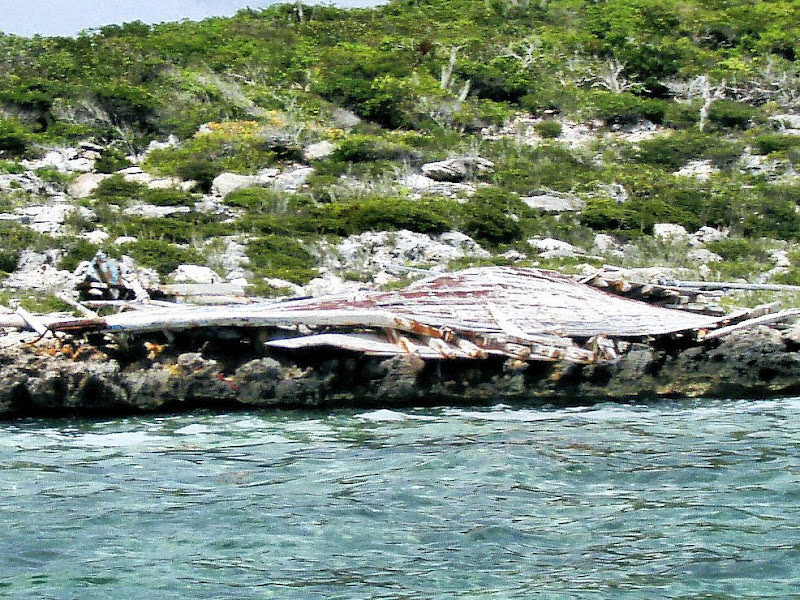


We are pretty sure this is part of whats left of the sloop photo I posted a month or so ago. It broke up, and this drifted in.

And this one:


We also passed several areas where nice big pieces, well HUGE pieces, of ocean cleaned, polished, and cured driftwood collect. We can just drop the hook, wade ashore, and pull them back to the boat. Its all tropical hardwood. I sure know where I am going to go shopping for weathered boards and driftwood once I get my shop up and running. I have some ideas for the boards from the sloops already, and have a driftwood tree in mind for a hammock stand.

We thought a lot about storm surges and hurricane waves when looking at building lots. The good thing about being on this side of the island is that the Caicos Bank extends outward from those lots a distance from 18 miles to the reef drop-off at the closest point, to over 30 miles to the southeast. It's got an average depth of probably something around 10 feet for most of it. That expanse of shallow water is going to naturally limit wave height at the shoreline. Waves just cant get that big in ten feet, or less, of water. It doesnt get ten feet deep in front of those houses until you get almost two miles out. They are sitting roughly eight to ten feet above sea level. I think they will be okay,except in the most extreme hurricane. Those houses I just posted photos of are in much better locations than many I could show you.

Having said that, the last really serious hurricane to hit these islands was almost fifty years ago. It's long overdue, statistically speaking. During that storm, Hurricane Donna, 1960, there was very little in the way of manmade construction on Provo. The population of the whole island was maybe 300 people. And those were native people, like our best friends here, the Stubbs family. They knew enough to build their homes inland, and on higher ground. There were a few dozen houses here, at most, in those days. Not much here for a storm to tear up. And nobody much to notice if it did. No highways, electricity, just some docks. Very simple lifestyle then.

Now, it's all different. It's all built up by people who have never been in a hurricane. My feeling is that the next major storm to hit here is going to cause massive water damage to a lot of properties that have sprung up right on the water. The winds are going to point out any building mistakes or shortcomings in the multistory hotel designs. The houses are built from steel reinforced concrete, and the walls will probably withstand the wind even if the windows and roof let go. But the power of the ocean, well, I think a lot of people just either dont realize what can happen, or they have chosen to take the gamble. It's all still academic to most of the owners of these homes, and many of them are vacant vacation homes during hurricane season.

We built on this side of the island, but the floor of our house is almost 60 ft. above sea level. Maybe I am getting more cautious in my old age, but we chose that site with that as one of the criteria, height. of course it also helps the view, and the breeze. We do have to walk across the road to climb in the water. We didnt see that as being a huge drawback living here full time, since no place on the island is farther than a mile or so from the ocean. Theres PLENTY of beach. Besides, we boat to remote beaches when we want to play in the sand. We have almost come to think that living on the beach is for people who dont have boats.

I think the houses on the beach, and the canal lots especially, on the other side of the island are going to be more affected by storm surge. Many of those are built with a lot of fill, and are maybe six feet above sea level. And they are closer to deep water. the reef comes to within a quarter mile of the beach in places, and its five thousand feet deep just on the other side. And the water between the reef and the beach is 20 ft. deep over there....well, you can see what could happen. The terrain also slopes at a shallow angle on the other side. This side has this natural rock barrier, the edges might crumble off, but the rock isnt going to wash away. It's also not going to flood,either from rain, nor from storm surge.

At least, thats our thinking on it. We intend to be in that house during the next hurricane, so we tried to think it through pretty carefully. If we can just scrape through this season unscathed, until the house is built, the generator is installed, etc. we should be okay going forward.

Thursday, October 11, 2007

Forum comments, island life thoughts, groceries,

I just got back from the hardware store and visiting the house site a little while ago. Couldn't find JB Weld, which was recommended to me on the boating forum, but found some stuff called "Seal-All". Its advertised for sealing up leaks in gas cans, etc. Gonna give it a try.

Still going through photos we took last weekend. One was this very unusual ( to me, anyway) coral growth. This is right next to another photo I posted of two coral heads. But this looks much newer to me. And its shaped strangely. I haven't seen anything that looks like this on the reef before. The formation is about four feet across, and that's a bit of exposed limestone in the middle. Any of you guys ever seen coral do this?


Stopped by the house. Took a bunch of photos from the patio area and stuck them in a panorama. Its coming along slowly. They are mostly working inside walls and doors this week:
Gringo/La
A comment from the THT boating forum:

" like others here, I have totally enjoyed following the life and times of you two on TCI. With so many folks looking forward to, and almost depending on your daily updates of island life, (almost like Howard Stern) how has that changed your daily mindset? Do you leave the house now thinking that you have to find something interesting to photograph or run into someone interesting so that you will have something "exciting" to post for us landlubbers? (Folks here, me included, are actually interested in the process of you drilling a hole in your boat) Do others on the island know that you are sharing their lives with us? Are you amazed that so many are interested in what you cook, drink, look at or photograph? Are you two finding this the least bit amusing? I AM!

Do you realize that you now have a responsibility to "entertain" an audience of stateside dreamers? You really are an escape from the crime ridden and politically charged headlines of our daily lives. Please keep taking and posting the "seemingly mundane to you" pictures and make sure you write about those "uninteresting" locals that you run into on a daily basis, as these seem to be characters and threads that keep us dreamers dreaming! "

Actually, we haven't changed our mundane daily routines much at all as a result of this thread. Nothing posted here is anything we wouldn't have been doing anyway. We boat, fish, dive, check out new places, and hang out with local people as a normal part of our life here.

We do try to remember to grab the little camera now when we go somewhere. And we try to keep an eye out for anything that we think someone might find amusing. But we don't really go out of our way to find it. We did go back to the stone cats and the little cave, specifically to get more photos to post, and we used this thread as justification to go back up to Sapodilla Hill, but we would have eventually gotten back to both of those places anyhow. That was our fourth trip to Sapodilla.

We are pretty amazed that people somewhere find this interesting. Its hard to believe there have been almost 70,000 viewings of this thread. But what does that number mean? Could be twenty people who check in a few times an hour.... Could be twenty thousand people who took a look once and moved on. We have no way of knowing. The only gauge we have are the responses.

We were talking about it last night while watching the sunset. I was wondering if it was worth getting up and grabbing the camera, and the answer was "nah, its just another tropical sunset, they've seen that already". Its like the photos of the house going up, I feel almost like one of those old cliche' neighbors who invite you over to show you their vacation movies. A boring hour of their kids sticking their tongues out at you under a sign from the Grand Canyon or Niagra Falls. At what point are we boring people with house photos? Are they being polite and nodding their heads and saying 'yeah, very interesting' while thinking " Christ, not yet ANOTHER photo of the stupid pergola..."??

We have happily found that taking photos specifically to show to other people has given us a fresh look at this place. We took the photos all along, we just never showed them to anybody. When we first got here, EVERYTHING was exotic, foreign, and strange. It was nervous in places. Was this area dangerous? Are those people looking to rob you...etc. ( Did we tell you we were sitting in a restaurant when two armed guys in masks burst in and robbed the place fifteen feet away from us?)

Now, two years later, it feels normal, for the most part. Its like the first time you have to drive in Boston traffic, as compared to how it feels after five years of driving in it every day. The perspective changes. We do find something to laugh about, or shake our heads over, almost every time we leave the house. Watching the local news here is usually good for a few grins. And the three weekly newspapers are a flaming hoot, for sure. I should scan some of these articles and post them.

A lot of that initial excitement and heightened sense of not being "in Kansas any more, Toto, " that you get when landing in a new place fades with time. Its like vacationing in the same place every year, as compared to what the first vacation in a totally new and foreign place is like. Familiarity. What once was remarkable becomes commonplace. Putting the photos on this thread and then seeing the reactions of other people makes it all new again. La Gringa certainly wouldn't have bothered taking photos of Harry and I cleaning conch six months ago. There was nothing unusual about it, to us. But we thought, hey, maybe somebody SOMEwhere would find it interesting for a couple minutes. Someone who has never seen someone clean a conch, if such a person even exists.. So we post that, and get very little feedback at all. We got more interest in the drywall in the house. So, we scratch our heads and file that away. People ain't interested in conch. Okay. No problem. We aren't either. We catch em and eat em. But what ARE they interested in?

Its also giving us some incentive to make good on some of the things we have been talking about doing. We can use the excuse "hey, we need some fresh photos" to justify getting off our butts and firing the boat up. The local guys don't follow the internet for the most part. Some do, but not many. Most of them wouldn't be able to find the power switch on a computer. Evan could, Preacher couldn't, etc. So no, they don't know they are characters in a boating forum. I do try not to write anything about them that I would be ashamed for them to read, though.

So, that's kinda my take on it. We do need some feedback as to what people want to see. As was pointed out, its definitely an inter-active thread. Got questions about the TCI or what its like to pack up your life and move to a small, foreign island? Well, here's your chance to ask.

(On a question about buying property here)
Ok, looking at present land and building values, and knowing what we have learned living here, this is what I would recommend someone look at if they wanted to do essentially the same thing:

1.) First you have to determine whether or not you have to have waterfront property. If you do, you will be spending anywhere from about $ 500K and up if you want your property to touch the ocean. What kind of waterfront....do you want to live on a canal so you can tie up on your own dock? Do you want a sandy beach, no canal, keep the boat in a marina or on a trailer instead? Or are you happy with craggy rocks, no dock, no beach? $ 700K should find you about an acre on a rocky shore like near where we are building. $ 500K should get you a canal front lot of maybe a quarter or third an acre, with some neighbors close by. If you want the sandy beach, you are probably looking at a million and up. But all that is still available at the moment.

You need to decide which island you want to live on, and that would depend upon a lot of things. How close to schools, stores, big airport, medical etc. you want to be. Are you willing to live more remotely? Its cheaper to buy property more remote, but your support costs will be higher. Your building costs will be higher if you have to transport materials and crew. It will take longer. You might have to boat to another island for groceries and hardware, for example. Costs to run utilities need to be considered. If we were doing it again, I think we would be looking in the Long Bay Hills area, where you can get an acre of elevated land with an ocean view ( not water front) for under $ 200K., the utilities are already run, and the government is planning to pave the road within the year. Its off the beaten paths, but not too remote. There's a marina right down the road. how badly do you want to live right on the water, knowing you will never be more than a mile from the ocean no matter where you live?

Whatever you buy, it looks to be a pretty good investment whether you improve it or not. Land has been appreciating for around 30% per year since we started looking. they just don't seem to be building many tropical islands anymore.

Buying the land is not difficult. Its pretty much the usual type of realtor stuff, and lawyers to do title searches etc. But its not as complicated as the States. Land has only passed through a couple hands here, at most. You will pay a one time 10% Stamp tax on the value of the land, at the time of purchase but then no property taxes from then on. You would pay the 10% on the total value of the property if you bought an existing house. you do not pay 10% if you build a house. That's worth considering, for several reasons. The 10% one time stamp tax you would pay for an existing house would go a long way toward paying your rental costs while you build, for example.

You could also consider buying an existing house and having it upgraded or modified. There are plenty of realtors with websites here.

Building will run you anywhere from $ 250 per inside sq. foot up to whatever level of luxury you want. I would think you could build a pretty nice place for $ 300/ Sq. foot. but $ 250 would not be a dirt floor hovel, either. Its in the type of flooring, doors and window quality, roofing, appliances, etc. The basic house structure and building methods will be similar for any house, due to the new building codes. Its gonna be CBC and poured concrete. Do you want a pool?

We hired an architect. I don't think we would do it again if we built a second house. We would find the right builder ( and we know several) and sit down with him and come up with the plans we wanted. But I know quite a bit about construction, so it wouldn't be too hard for me and a good builder to design a house. Would save a lot of money that way.

Figure a year to get the permits and build the house after you have bought the land. If you can swing it, I would recommend staying in the US while its being built, and flying down once a month for a few days. Find someone local to keep an eye on it for you, until you get a feel for the builder. Some builders you could trust to handle the whole thing. Others you might want to keep on top of, not because they are dishonest, but because they might have a lot going on and the squeaky wheel gets the grease. Hiring the architect definitely did help with that, and that may be worth it to most people. But I have found myself doing a lot of the "job foreman' aspect of what we paid the architect to do. That's just me. I couldn't keep my fingers out of the day-to-day aspect of it even if I tried.

Gas money and food, well, gasoline is currently $ 4.30 a gallon here. But the whole island is less than 20 miles long. A tank lasts a long time. We spend more on gas for the boat by far. Food will cost you about 30% more than you pay at grocery stores in the US. Conch is essentially free if you get it yourself. Restaurants are on the pricy side, but it varies a lot. You can still get $ 12 lunches. A really good pizza, large, with ground beef, pepperoni, bacon, mushrooms, onions, tomatoes, and extra cheese runs right around $ 25. if my sources are correct ( we do that every Friday night when we are on Provo). A bit more if you wait for it at the restaurant and knock back a few drinks while catching up on the local gossip at the bar. Beer is expensive here ( shipping costs based on volume), Rum is way cheap.

2.) "Visas". When you come into the airport immigration here, they will stamp your passport for permission to stay up to 30 days without any hassle at all. If you need to extend that for another 30 days, you can do it by going down to Immigration and asking, essentially. Minimal paperwork. You can do that every time you visit, but you gotta leave the country between visits.

If you want permission to stay here for longer than that, you get into the whole Resident Permit thing. There are several types. The ones we got are Temporary Resident Permits, which we renew on a one year basis. Costs us about $ 1000 per year to renew, and the renewal is essentially a rubber stamp process after the first year if you keep your nose clean. Initial permit was more of a hassle. Needed letters from the police in the US stating we had clean records, you need to prove ( via financial paperwork) that you can support yourself while you live here without working here. You have to get a blood test for AIDS. That $ 50 locally, no probs. They also check for syphilis while they are at it. Kind of a two-for-one deal.

There are other permits you can get. It depends on whether you want to buy a business here. Permanent Resident Permit is the same as a one or three year renewable, its just more money up front for a lifetime permit. Other permits apply if you want to buy and existing, or start a business here. What kind of business. Whether you have a job working for someone else here ( that's complicated). The best situation is if you have investments in the US that produce enough income for you to live here. Or if you are a writer, or can work online, something like that. But if your source of income is not here, its very workable. They are most concerned about you competing with locals for existing jobs. They are happy if you want to risk your money to start a business and hire locals. Its complicated. Check out this site:
http://www.immigration.tc/go/en/Naturalization-BOTC--page.html

Its way more info that you need, and concentrates more on citizenship, which a lot of Haitians are seeking, not Americans. but look at the application forms PDF files and some of the links.
Well,I see I spelled "rehearsal" wrong...but I must have read it somewhere. I'm not that deep. If I knew, I would have certainly credited it.

Maybe its a paraphrase of Charles DuBois' "The important thing is this: To be able at any moment to sacrifice what we are for what we could become." applied to making big changes in general. Without getting too much into our own situation, I would say that La Gringa and I individually had our own experiences in fire-hosing off the decks of our lives and making course changes. When we got together, some philosophies fell into place with positive reinforcements for both of us this time. Neither of us had that before. When striking off in a major new direction like this, if you've got a partner, its absolutely GOT to be a like-minded partner or somethings doomed.

That, and some more recent life experiences, tipped the scales and we decided to go for it. We've never looked back. We wish we had done it years ago.

We truly didn't know if it would work, when we arrived here to see if we could live in a foreign country, and on a small island. It's definitely NOT for everybody. It was different than we had imagined, but not worse. The first time we had to deal with Immigration people was daunting. The first time we imported something and had to go through the ocean freight, customs experience. Getting a TCI driver's license...buying and registering vehicles.... buying property, building a house, arranging cable tv and internet and telephone services...it just keeps getting easier. And the more friends we make, the easier it gets. And as pretty as the water is here, the people are really the beautiful part.

We meet a high percentage of like-minded non-native people here, of course. Some live here, and some we meet passing through on catamarans. We typically strike up a conversation about the boat, and get invited on board. We have also seen people come down here and decide to go back to the US/UK/Canada/Australia/etc. after a few months. You have to be able to get through those first months when its all alien and strange, intimidating, and frustrating. Driving all over the island on the left without any brakes while looking for a tube flaring tool to patch a piece into a corroded brake line while lying in the dirt on the side of the road is way different from sitting in Club Med perusing menus for a week. We laugh about that now.

It could all turn bad tomorrow, of course, but can't you honestly say that about any place, at any time in your life?

Unfortunately, today has been slow. We did scoot out to the best grocery store on the island for a few things, and I took the camera thinking I would get some typical grocery store photos, with lots of empty shelves. But it was not to be. They just got some containers of food in yesterday, and the shelves are full again.

We have become hoarders. We go to the store shopping for groceries with a totally open mind, because we cannot plan on what we will find in stock. We have seen them run out of milk for two weeks at a time. Bottled water several times. Frozen orange juice. Every kind of meat. Sometimes there is no bread. And we are coffee fanatics, we use espresso and brew it in a normal drip coffee maker, and we have our favorite brands. And they change every couple of weeks because we have to adapt to whatever is in stock. The upside of that is that most of the stuff we do get is better than the finest Starbucks you can buy in the US. We usually get beans and grind them ourselves, but we are coming to know a lot of different coffees. And in general, they are better than the shelf stuff in the US grocery stores by far.

So, my plan to get some photos of empty shelves didn't pan out today. I did snap a couple shots just to have SOMEthing to post...like this one in the dairy section:

Note the little tags with nothing stocked above them. And note what stuff there IS stocked, is only a few varieties, and its only stocked one row deep. And this was a pretty good day, actually. Most shelves were filled.

On another note, just curious, but what do you guys pay up north these days for your raw White Yam (not the yellow), Boniato, Malanga, and Yucca root?


The shipwrecks and the caves both fascinate me a lot. Pirates were very very active around here. These islands were essentially un-inhabited, and not patrolled by other nations back in the day. These little caves have been around hundreds of years. People had to have used them for shelter.

This one, for example. Its a better angle of one I posted earlier. That entrance is big enough for three or four people to sit in, and it goes back into the hill. And these are all over the place.

Wednesday, October 10, 2007

Caicos Bank, gas tank problems

One third texmati rice, two-thirds La Gringa's conch chili, with a half inch of shredded cheddar on top?


I am still looking through the photos we took on our last foray onto the Caicos Banks.

This is what the top of one of the little uninhabited cays looks like, much lusher than I had expected:


The branches that look dead....they aren't dead. They go dormant when its dry, and green up real fast during the rainy season. This cay was probably mostly gray and brown on top two weeks ago, but we just had five or six days in a row with rain. If we came back to this same spot in another week, and took the same photo, I think you would see very little vegetation looking dead.

This cay is also thick with rock iguanas. La Gringa saw three of them, and then they all ran into the bushes. We could hear them rustling, and if we had been still and patient, we would have seen them for a photo. But we needed to move on. There was another cay just a little further away we wanted to see, too...

One of the reasons these little cays support life is the sinkholes. You come upon what looks like short trees, and when you look closer you see that they are actually six or eight feet tall. The bases are down in a sinkhole, where topsoil and rainwater collect, and the limestone holds the water. this one is about five or six feet deep. Its own little hidden world:


Well, I guess I will try to keep the thread going through good stuff and boring. Crummier photos will probably need more words. Good photos should be able to essentially stand alone.

As for a look at my day, yesterday it wasn't that exciting. I cut a hole in my boat. I have been chasing a fuel leak, and one area I could not get to, nor even inspect, was where the fuel and vent hoses connected to the tank. It was right under the deck.

SO, after gathering up my tools, screwing up my courage, running out of excuses, and buying a hatch, I went to the marina and prepared to operate. First, I measured and remeasured the numbers I got from the manufacturer about where the filler SHOULD be located, 193 inches from the outside of the transom, and 51 inches from the bow loop.

But, there are different ways to interpret "the outside edge of the transom". Transoms have all kinds of outside edges. They are not flat boards. And the same with the bow painter. And neither measurement is straightforward...you cant just measure up the center of the boat. There is a leaning post, a console, and a front seat in the way. You can measure along the top of the gunwale, but the transom is not a flat plane, and the gunwale is not a straight line, either.

As for the bow loop ( painter) well, there's a minor difficulty measuring from it, since its on the underside of the hull, under the bow, and there is an anchor locker between it and you...

So, I laughed, I cried, I prayed to various gods who should be watching over fools and mariners..and through a system of idiot's geometry, measuring several thousand times, using a boat hook across the gunwales and a washer on a string as a plumb bob....I made a mark:


You don't know what went into the making of that simple pencil mark. Leona Helmsly's plastic surgeon didn't sketch that first scalpel cut with any more care and thought... An explosive ordinance expert unscrewing a rusty bomb fuse would have appreciated the precision... I mean, this is my BOAT we are talking about here...

I needed to cut a 6.5 inch diameter hole for the hatch. The smallest hatch I figured I could install that would still let me get my hand and a tool inside the hull. And it had to be precisely over the right spot. So, after praying for rain, lightning, a water spout, a surprise interrogation by the police, ANY reason to delay, finally, I screwed up my courage and decided to deface my boat. I cut a 2 " hole first, using a hole saw. I did not know how close I was to fuel fittings and was very mindful of just how many sparks an electric motor makes..


Well, after the first hole is cut, it does get easier. I was committed now. No going back, once you cut a hole in your boat you have to deal with it. Holes in fiberglass boats don't just go away on their own. I now knew that the center of the bigger hole needed to be a couple inches aft of the original pencil mark. If you look in that little hole, you can see hoses. you do NOT see fittings and hose clamps. Not exactly the right spot. Man, am I ever glad I cut the small hole initially.

I also was able to feel the filler and vent hoses, and they were up against the underside of the deck with maybe an eighth of an inch clearance. Depth of cut gets a bit more critical at this point.
I got Bernard the Haitian Shipyard Worker to hook me up with power, and used the Sears and Roebuck version of a Roto-Zip tool I brought down from the States with me. Its just basically a power tool like something Swarzenegger would buy when he only needed a Dremel. It came with a circle cutting attachment:


You can see that the center of the circle is NOT where the center of the two inch initial hole was located. But that worked out okay. If it had been, I would not have been able to so easily use the circle attachment.

So, after cutting the big hole, it was relatively easy to run the silicone bead around the hatch fitting, drill six small holes, and install the hatch:


So, its done. Do I like having a hatch in the middle of my deck? Nope. But do I like having access to the four hose clamps ( jubilee clamps to you Brits) that hold the fuel filler and vent hoses, and the welds of the tank where I can get to them? absolutely.

So, after that I spent another hour working on other little projects on the boat that needed doing..there are ALWAYS other little things that need doing. But that's what I was up to while y'all were discussing choices of islands and health care. Not too exciting, I know. And its raining again.

I didn't find a "smoking gun" at the hoses. The welds don't look cracked, which was an unknown that's now gone away. Some peace of mind value, there. Would have been a major deal, involving taking the boat apart, being without it for a long time, lots of money..etc. I was able to tighten the hose clamp screws on the filler maybe an eighth of a turn. The two holding the smaller vent hose on, I was able to get a full turn on those so its a possibility that was a leak

In the meantime, I have been concentrating on the sender assembly. Still the primary culprit. Last time I put it back together after it leaked on Sundays excursion, I used the paste Teflon thread sealer instead of tape. If it leaks around those, I will now go to Teflon tape. I didn't want to because I don't want any Teflon tape shreds in the tank. But I know they are small, they are not likely to fall in if I do it right, and anyhow there are two fuel filters between the tank and the motor. yesterday I tightened those five machine screws and they feel solid, the four originals and the one I tapped out to quarter twenty-eight.

Now, we have to fill the tank with fuel, once again, and look for leaks. At least this time we can look everywhere for leaks, and if it leaks again, I should be able to find it. One last thing I am wondering about are the two pins that go through the sender plate for electrical connection to the floats variable resistor. I just don't think those senders were designed to be under any liquid fuel pressure, and these are. I am going to NAPA today to see if they have any kind of solvent proof stuff I can use to seal around the two pins.

I saw a Dirty Jobs episode this week, where Mike Rowe was using some goop to seal the inside seams of an Air Force tanker's wing tanks. Wish I could find some of that stuff.

But Teflon tape and some pin sealer goop is my next Plan B. You always gotta have a Plan B here. Even when Plan A seems to be working.

As for the panga, six months experience with it proves to me that it was an excellent choice for these waters. We really like it, and it takes us places many boats cant go. And its fast enough. My second choice would be a catamaran with as shallow a draft as I could find, and two outboards. It's the boating equivalent of comparing a dirt bike to an ATV...with coral heads and narrow reef cuts being the trees you have to go between and around.

Monday, October 8, 2007

Conch Chili, gas tank problems, Caicos Bank photos

Someone had asked some time back about how we cook the conch. Well, yesterday’s justification for taking the boat trip ( like we needed one) was to make up a batch of “conch chili”. We call it conch chili because the lady we got the recipe from originally calls it conch chili. She is a Bahamian, and a long time friend of La GringaSuprema. She owns the Sip Sip restaurant on Harbour Island ('Briland’) in the Bahamas.

Since its got peppers and onions in it, I suppose a Bahamian would think of it as chili. I am, however, a Texan. We would not call it chili in Texas. Its way too mild for that. We would, however, call it delicious.

Steps one through four were to move to the tropics, buy a boat, learn how to find conch, and put in the time learning how to clean conch. (If you got access to conch, you can skip steps one through four)

Next you assemble all the ingredients you need. This is enough for two batches, heavy on the conch. That’s 19 cleaned conch in the bowl.


Note: La Gringa Suprema assures me the mug of rum and OJ is required, although I don’t see it listed anywhere in the recipe itself.

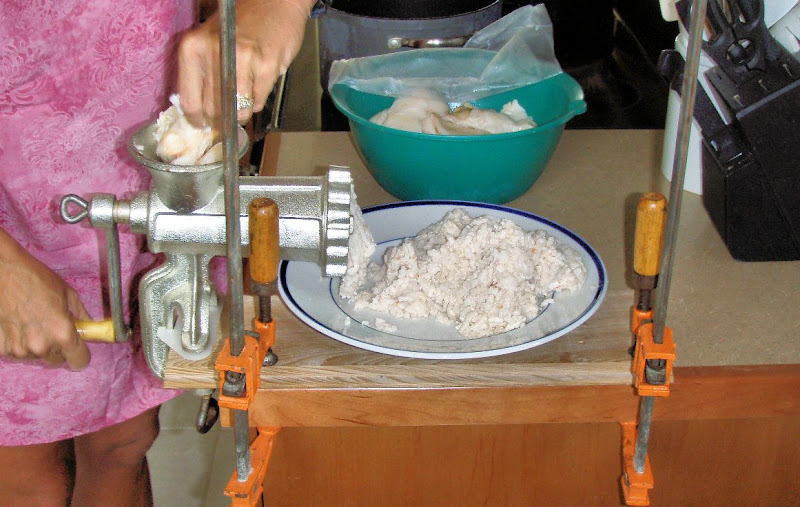
Then you try to figure out some way to clamp a meat grinder to a counter top that’s a.) too thick for the clamp, and b.) not YOUR counter top. Hey, with some scrap clear cypress from a certain construction site, and a couple good clamps, many things are possible.


Then, while you take the photos, your better half grinds up the conch. We only grind it up for two dishes, this chili, and conch fritters. For all the other recipes we use we slice and pound it. When we do the chili, we typically do enough for two batches. It's like a lot of other foods I can think of ( lasagna comes to mind, and some meatloaf) its actually better after its been frozen and then re-heated. The recipe for this even says to make it one day, refrigerate it overnight, and heat and eat it the second day. All the flavors blend together better I think.

So, this is one batch. She cooks it in two separate batches only because that’s the biggest pot we have at the moment.


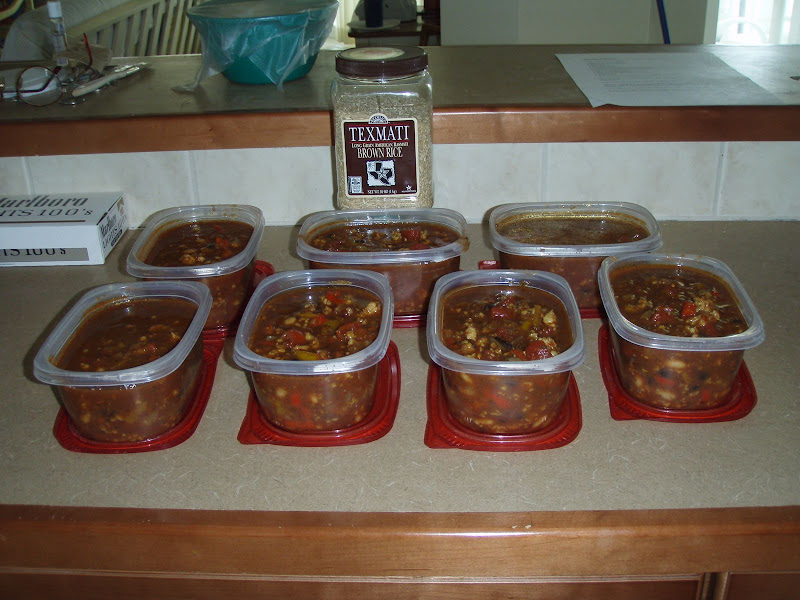
After it cools off a bit, it goes into these little containers that just happen to hold enough for two servings each. One pot is seven of the dual servings, So with the second batch now cooking, we get 28 dinner servings out of yesterdays trip. Its worth it. And I only know one restaurant where you can get this stuff.


We typically nuke it or heat it frozen on the stove, and then serve it over rice:


If we are out of rice, its just as good over pasta. Or by itself. Put lots of grated cheddar cheese on it. It has a sweet taste to it, nothing like spicy chili. It would be easy to add some jalapenos, or habaneros (scotch bonnets for you Brits) to it, but we never know who we might be serving it to. Lots of people don't like it that spicy. The locals here, for example, wouldn't touch it if it had habaneros in it. So we make it mild and let people add what they want.

We have been known to hit it with the odd shot of hot sauce. Anything from mild (Tabasco, or Crystal) to more serious ( Dave’s Insanity, or Endorphin Rush) will certainly warm it up if you like spicy.

wow, I just noticed this is up to 36 pages...unreal. Who woulda thunk it? and we have some pretty good trips in the planning stages. French Cay is probably next. I think I am starting to get a handle on taking the underwater photos. We are going to be adding a metal detector, Preacher is still talking bout a Salt Cay trip, we still want to see East Caicos and the ruins of Jacksonville, we have the entire Caicos Bank to explore ( Big and Little Ambergris, Seal Cays, etc. There are 42 islands here) and of course the move into the house should be a real Keystone Kops...hopefully without the cops.

And people tell me the fishing starts picking up soon..

And I'll keep posting as long as its entertaining somebody and there's interest.
We are really happy that people are enjoying this thread. It's fun for us, and it's really not much trouble. I just try to remember to drop the little camera in my pocket when we leave the house. Uploading the photos to Image Shack is the only part that's time consuming, and that's really something like 30 seconds per photo. This is all stuff we do anyhow. I do wish I had been taking more photos in the two years we have been living here. There were a lot of things I wish I had documented.

Not much new to report today. It started out looking like another good weather day at dawn:


I need to work on the gas tank on the boat again, I have yet to find the leak. That's part of the reason we aborted the trip out snorkeling on the reef Sunday. We had filled the tank at the marina, after I think I fixed the small leak where the fuel gauge sender goes. But when we got out to the reef we discovered a lot of gasoline in the bilge, again. We needed to run the boat for a while, to burn the fuel level down to three quarters of a tank. It doesn't leak then. So, we went cruising and you have seen where we went.

So about all I can think of that it still could be is where the filler hose or the vent hose connect to the tank inlets at the forward end. Unfortunately, that is not accessible. Nor even visible. Its either that or a cracked weld which is unlikely.

This morning I drove down to the boat parts place, and bought an 8" deck hatch. Got blocked in by this decrepit old van, and was getting a bit aggravated until the two guys who were driving it came out of the store. They had to be two of the most stoned rasta men I have seen in a while. I COULD be wrong...its possible. coulda been paint fumes, or something.

Then went to the hardware store to buy a two inch hole saw. Ran into one of the best Yamaha mechanics on the island. Our friend Evan is working for him now. That's a good thing, I reckon. Having one of our best friends training as a Yamaha mechanic.

Then it started raining. I am not going to go run power tools in the rain, I guess. I am already nervous about cutting into the deck above the fuel tank.
Afternoon thunderstorms are normal this time of year. About the most exciting thing that's happened all morning is having to wait for a crane to cross the road...


I swear he was moving slower than the Rastafarians...but his eyes weren't nearly as red and he wasn't laughing hysterically and slapping his knees while trying to find his car keys...

Then he took off, but instead of flying away he decided to fly right down the road.


This crane flies at about 8 mph. Thankfully, he entered a left crosswind to stay in the pattern, I guess....while I opted to fly a right turn-out and head home. High drama in the tropics!

But I gotta tell you, it beats road rage on I-95.

So, Will I get to the marina to cut a hole in my boat today? I don't know. It's raining. But I did manage to make a major step in that direction, got the hatch, some silicon, and a hole saw. Patience....patience......patience......it's da islands, mon.

You cant be a "Type A" and live here happily. It'll either cure you or it'll drive you nuts.

I'm still wading through the 119 photos we took Sunday, thought I would stick up a couple blue ones.


"You know the ocean is a desert with the life underground and the perfect disguise above...."

('Horse with No Name', America)


Imagine you are a keel, and you are cruising along with twelve to fifteen feet of water under you. Ever wonder what it would look like to suddenly come upon a coral head that came to withing three feet of the surface?